
User Page (Blog)
VSE Tietê
on February 23, 2017
EXTENSION EAST
on February 23, 2017Supply pipe Guarapiranga
on February 22, 2017Pinheiros river wastewater pipe
on February 22, 2017Wastewater system Sanegran
on February 22, 2017National rail network - Lisboa
on February 22, 2017The National Railway Network has approximately 2562km composed by lines and extensions in exploration, 1633 km of lines and extensions electrified (2015 census). It has more than 500 stations, between those Penalva Railway Station, which tunnel is located near to its, it is a railway interfaced in South Line, that serves Freguesia de Quinta do Anjo, in Concelho de Palmela, in Portugal.
CJC developed the detailed project, including earth moving, retaining, excavations, structures and installations, besides author’s supervisions of Penalva tunnel for Zagope Constructor.
Huancayo - Huancavelica
on February 22, 2017The Huancayo-Huancavelica railway, also known as “El Tren Macho” is a historic railway currently in operation, with an extension of 128 km. it connects Huancayo and Huancavelica city, in central mountains in Peru. It is composed by Chilca (Huancayo), M. Tellería, Izcuchaca, M. Cáceres, Acoria, Yauli e Huancavelica stations.
The work about the upgrade of “El tren macho” started in 2008. Currently the Huancayo train to Huancavelica has your travel time reduced from six to three hours. In this way Huancavelica, capital of one of the poorest regions in Peru, was connected by a stretch of 128km with a flourished business location of Huancayo. The city will also be connect to Lima thru the central railway station, which is going to be a powerful tool to increase the agricultural production, trade and tourism.
CJC worked (by F. Ferraz) in the basic project to the recovery of the NATM tunnels, bridges and contentions in this railroad.
Source: https://es.wikipedia.org/wiki/Ferrocarril_Huancayo-Huancavelica
Marembá tunnel
on February 22, 2017The Marembá Railway Tunnel, belongs to Vitória a Minas Railroad (EFVM) located in Caetés (MG) between the km 42+620,00 (Costa Lacerda tunnel entrance) and km 44+732,84 (Capitão Eduardo tunnel entrance), the tunnel has an extension approximately of 2,1 km, while the railway in its total has 664km and your trains can reach 70 km/h.
CJC developed the enhanced recovery project to NATM tunnel in this railway, indicating solutions to the reinforcement project improvement and its interventions.
Sources:http://www.vale.com/brasil/PT/business/logistics/railways/Passenger-Train-Vitoria-Minas/Paginas/default.aspx ; http://viatrolebus.com.br/2016/12/trem-de-passageiros-volta-a-operar-entre-vitoria-e-belo-horizonte/
FERROANEL – SP
on February 22, 2017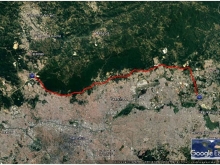
The São Paulo Metropolitan Ferroanel (also known as Ferroanel) is a Railway Connection Project between the main railways that cross metropolitan region in São Paulo. The project is complementary to Rodoanel and will use part of its geometric design to soften the environment interventions. Ferroanel will have 2 lines: North line (Eng. Manoel Feio station — Campo Limpo Paulista station) with an extension of 66km and south line (Evangelista de Souza station — Rio Grande da Serra station) with an extension of 55,3 km.
CJC works in the development of the functional design in Ferroanel north tunnels.
Source: https://pt.wikipedia.org/wiki/Ferroanel_Metropolitano_de_S%C3%A3o_Paulo
Aço railroad - MG
on February 22, 2017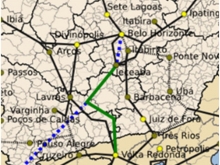
“Milagre Econômico” (“Economic miracle”) era, during the military rule. The railway construction was announced by Brazilian government in 1973 and it was no more than the realization of an old project of a specialized line for iron ore transport The steel railway, also known as The 1.000-days railway, is a Brazilian railway designed in that Rede Mineira de Viação had already recommended in 1956. It has more than one hundred tunnels in its path, between those, Tunelão, the biggest railway tunnel in Brazil, with 8,6 kilometers long, connecting Jaceaba (MG) to Barra Mansa (RJ). The maximum design speed for this railway is 140 km/h.
CJC members work in the NATM tunnels detailed and retaining project, author’s supervision and consulting (by F. Ferraz), besides participating as builders in part of its extension, where its included 8 tunnels, among which Tunelão, with 8,6 kilometers long.
CJC ENGINEERING AND PROJECTS | +55 11 5589 9549 | Cubatão Street 86 - São Paulo - Brazil