
User Page (Blog)
LINE G
on February 21, 2017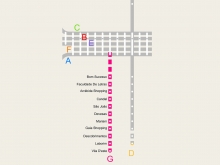
CJC developed the preliminary study between Casa da Música/Quinta do Cedro and Lamborim-Bombarral with approximately 5700 m in track tunnels, 8 ventilation and emergency exit shafts with stretches that ranges between surface, underground and elevated and 9 stations (Bom Sucesso, Faculdade de Letras, Arrábida Shopping, Candal, São João, Devesas, Mariani e Gaia Shopping).
PORTO METRO – PORTUGAL
on February 21, 2017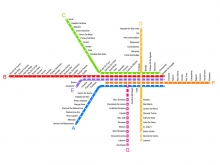
Porto metro is a public transport system of Grande Porto, Portugal, that consists in an electrified railway network, underground in Porto Center and in outskirts surface. It is a recent network, divided in 6 metropolitan lines (with eight services, including an express service) spread for eight municipalities in the metropolitan area: Porto, Maia, Matosinhos, Póvoa de Varzim, Vila do Conde, Vila Nova de Gaia, Gondomar and Trofa and a funicular line, Guindais Funicular. It has a total of 81 stations divided for 70 km of duplicated commercial lines, mainly in surface, with 9,5 km of buried network. Line A-Blue (Dragão Stadium– Senhor de Matosinhos), B-Red (Dragão Stadium – Póvoa de Varzin), C–Green (Campanhã - ISMAI), D–Yellow (São João Hospital– Vila D’Este), E-Purple (Dragão Stadium – Aeroporto), F-Orange (Fânzeres – Senhora da Hora) e G-Pink (Casa da Música – São Bento) compose the system. In the first 10 years transported 380 million users, having increased numbers: 53,5 million in 2010 and 57,7 million in 2015.
CJC worked in the basic projects and author’s supervision in line C-Greeen, D-Yellow and G-Pink of Porto metro.
LINE D
on February 21, 2017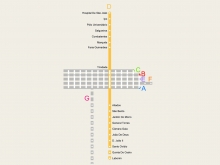
Line D or Yellow line, inaugurated in 2005, is one of the six metro lines in Porto and has 27 stations. It links Porto and Vila Nova de Gaia and has 15 stations operating. It has approximately 7,9km length with a travel time of 24 minutes and 45 seconds.
CJC developed the basic, detailed project and author’s supervision in Salgueiros, Marquês and Faria Guimarães stations, including all the architectural and constructive conceptions, excavation and structures.
Source: https://pt.wikipedia.org/wiki/Linha_D_(Metro_do_Porto)
PORTO METRO – PORTUGAL
on February 21, 2017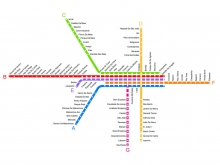
Porto metro is a public transport system of Grande Porto, Portugal, that consists in an electrified railway network, underground in Porto Center and in outskirts surface. It is a recent network, divided in 6 metropolitan lines (with eight services, including an express service) spread for eight municipalities in the metropolitan area: Porto, Maia, Matosinhos, Póvoa de Varzim, Vila do Conde, Vila Nova de Gaia, Gondomar and Trofa and a funicular line, Guindais Funicular. It has a total of 81 stations divided for 70 km of duplicated commercial lines, mainly in surface, with 9,5 km of buried network. Line A-Blue (Dragão Stadium– Senhor de Matosinhos), B-Red (Dragão Stadium – Póvoa de Varzin), C–Green (Campanhã - ISMAI), D–Yellow (São João Hospital– Vila D’Este), E-Purple (Dragão Stadium – Aeroporto), F-Orange (Fânzeres – Senhora da Hora) e G-Pink (Casa da Música – São Bento) compose the system. In the first 10 years transported 380 million users, having increased numbers: 53,5 million in 2010 and 57,7 million in 2015.
CJC worked in the basic projects and author’s supervision in line C-Greeen, D-Yellow and G-Pink of Porto metro.
LINE C
on February 21, 2017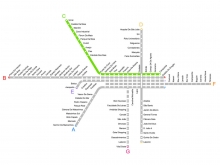
Line C or Green line, inaugurated in 2005, is one of the six metro lines in Porto and has 27 stations. It has approximately 24,3km length with a travel time of 43 minutes.
CJC developed the basic, detailed project and author’s supervision in Lapa tunnel, with the architectural and constructive conception, Trindade station, Bolhão station and Heroísmo station projects, including the basic project with architectural and constructive conception and author’s supervision in Bolhão station, also excavation and structures.
Source: https://pt.wikipedia.org/wiki/Linha_C_(Metro_do_Porto)
PORTO METRO – PORTUGAL
on February 21, 2017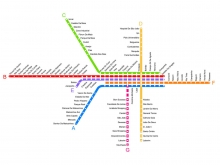
Porto metro is a public transport system of Grande Porto, Portugal, that consists in an electrified railway network, underground in Porto Center and in outskirts surface. It is a recent network, divided in 6 metropolitan lines (with eight services, including an express service) spread for eight municipalities in the metropolitan area: Porto, Maia, Matosinhos, Póvoa de Varzim, Vila do Conde, Vila Nova de Gaia, Gondomar and Trofa and a funicular line, Guindais Funicular. It has a total of 81 stations divided for 70 km of duplicated commercial lines, mainly in surface, with 9,5 km of buried network. Line A-Blue (Dragão Stadium– Senhor de Matosinhos), B-Red (Dragão Stadium – Póvoa de Varzin), C–Green (Campanhã - ISMAI), D–Yellow (São João Hospital– Vila D’Este), E-Purple (Dragão Stadium – Aeroporto), F-Orange (Fânzeres – Senhora da Hora) e G-Pink (Casa da Música – São Bento) compose the system. In the first 10 years transported 380 million users, having increased numbers: 53,5 million in 2010 and 57,7 million in 2015.
CJC worked in the basic projects and author’s supervision in line C-Greeen, D-Yellow and G-Pink of Porto metro.
YELLOW LINE
on February 21, 2017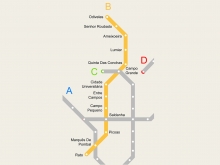
The Yellow line or Sunflower line, was inaugurated in 1959, is one of the four lines of Lisboa metro network, in Portugal. With about 11 km long and 13 stations, supporting a track from the center of Lisboa city to Odivelas city, in north. Mostly underground, it is the metropolitan line in Lisboa that has most surface passages.
CJC developed the detailed project and author’s supervision in Ameixoeira station, including the architecture, installations, excavation and structures.
Source: https://pt.wikipedia.org/wiki/Linha_Amarela_(Metropolitano_de_Lisboa)
LISBON METRO – PORTUGAL
on February 21, 2017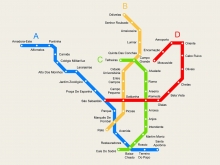
Lisboa metro network was inaugurated on December 29, 1959, becoming in this way the first metropolitan network in Portugal. It is composed by four lines with 56 stations (which six of those make a connection between two lines), with a total of 44,2km of extension. Lines A-Blue (Reboleira — Santa Apolônia), B–Yellow (Odivelas — Rato), C–Green (Telheiras — Cais do Sodré) and D–Red (São Sebastião — Aeroporto) make part of the system.
Source: https://pt.wikipedia.org/wiki/Metropolitano_de_Lisboa
Cais do Sodré Station
on February 21, 2017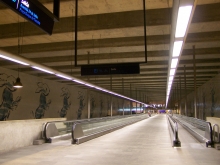
Baixa C. Station (Sunset Access)
on February 21, 2017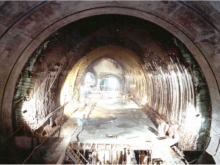
CJC ENGINEERING AND PROJECTS | +55 11 5589 9549 | Cubatão Street 86 - São Paulo - Brazil