
User Page (Blog)
GREEN LINE
on February 21, 2017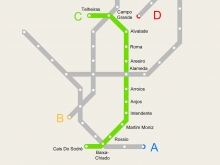
The green line or Caravel line, was inaugurated in 1959, is one of the four lines of Lisboa metro network, in Portugal. With about 9 km of length and 13 stations, supporting a stretch that crosses the city since southeast riverside until Amadora bordering district, in the northeast. It has an extension service with 316 m to link to Blue line, which has an immediately junction with the south of Baixa-Chiado Poente common station.
CJC developed the detailed project and author’s supervision in Cais do Sodré e Baixa-Chiado Nascente (by F. Ferraz) stations, including the architecture, installations, excavation and structures. Besides assistance and consulting during the construction and recovery of Telheiras and Alvalade stations.
Source: https://pt.wikipedia.org/wiki/Linha_Verde_(Metropolitano_de_Lisboa)
LISBON METRO – PORTUGAL
on February 21, 2017Lisboa metro network was inaugurated on December 29, 1959, becoming in this way the first metropolitan network in Portugal. It is composed by four lines with 56 stations (which six of those make a connection between two lines), with a total of 44,2km of extension. Lines A-Blue (Reboleira — Santa Apolônia), B–Yellow (Odivelas — Rato), C–Green (Telheiras — Cais do Sodré) and D–Red (São Sebastião — Aeroporto) make part of the system.
Source: https://pt.wikipedia.org/wiki/Metropolitano_de_Lisboa
Baixa C. Station (Nascent access)
on February 21, 2017São Sebastião I Station
on February 21, 2017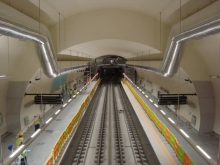
BLUE LINE
on February 21, 2017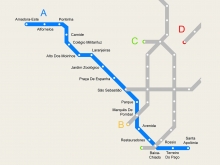
The Blue line or Gaivota line, was inaugurated in 1959, is one of the four lines of Lisboa metro network. With about 13,7 km of length and 18 stations. It is the only metropolitan line in Lisboa totally underground, without any viaduct. It has an extension service with 316 m to link to Green line, which has an immediately junction with the south of Baixa-Chiado Poente common station.
CJC developed the detailed project and author’s supervision in Reboleira, São Sebastião and Baixa-Chiado Poente stations, including the architecture, installations, excavation and structures.
Source: https://pt.wikipedia.org/wiki/Linha_Azul_(Metropolitano_de_Lisboa)
Lisbon Metro – PORTUGAL
on February 21, 2017Lisboa metro network was inaugurated on December 29, 1959, becoming in this way the first metropolitan network in Portugal. It is composed by four lines with 56 stations (which six of those make a connection between two lines), with a total of 44,2km of extension. Lines A-Blue (Reboleira — Santa Apolônia), B–Yellow (Odivelas — Rato), C–Green (Telheiras — Cais do Sodré) and D–Red (São Sebastião — Aeroporto) make part of the system.
Source: https://pt.wikipedia.org/wiki/Metropolitano_de_Lisboa
Red Line
on February 21, 2017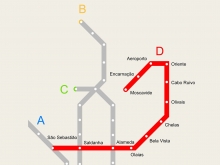
The Line Red or Orient Line, inaugurated in 1998, is one of the four lines of Lisboa Metro, in Portugal. It has around 11 km of extension and 12 stations, supporting the northeast region of Lisboa.
CJC developed the detailed project and author’s supervision in Saldanha and São Sebastião II stations, including the architecture, installations, excavation and structures in track tunnels between Oriente and Airport stations, besides the manoeuvring areas
and connecting tunnels, and ventilation and emergency exit shafts.
Source: https://pt.wikipedia.org/wiki/Linha_Vermelha_(Metropolitano_de_Lisboa)
LISBON METRO – PORTUGAL
on February 21, 2017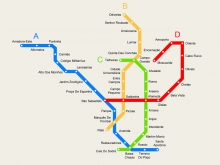
Lisboa metro network was inaugurated on December 29, 1959, becoming in this way the first metropolitan network in Portugal. It is composed by four lines with 56 stations (which six of those make a connection between two lines), with a total of 44,2km of extension. Lines A-Blue (Reboleira — Santa Apolônia), B–Yellow (Odivelas — Rato), C–Green (Telheiras — Cais do Sodré) and D–Red (São Sebastião — Aeroporto) make part of the system.
Source: https://pt.wikipedia.org/wiki/Metropolitano_de_Lisboa
Igarapava shaft
on February 21, 2017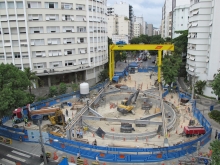
Line 4 – RIO DE JANEIRO METRO
on February 21, 2017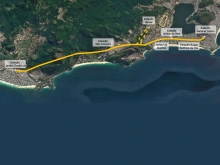
Line 4 is a recently inaugurated metro line in Rio de Janeiro that connects General Osório Station, south zone, to Jardim Oceânico station, General Osório located in Barra da Tijuca in the west zone of the city, passing thru several neighbourhoods where today runs some buses lines from the special service “Metrô na Superficie” (Surface Metro) and connection “Barra Expresso”. It transports more than 300000 users per day, it has 16 km long. It has an average duration time of 15 min from General Osório Station and Jardim Oceânico Station, reduces around 200 vehicles/hour/peak hour.
Line 4 departs from General Osório Station, goes thru Nossa Senhora da Paz and Jardim de Alah, Antero de Quental, Gávea, São Conrado stations and arrives in Barra da Tijuca, Jardim Oceânico station.
CJC developed the detailed project in Jardim Oceânico, São Conrado e Gávea (double) stations, as well as shafts, shield and NATM tunnels all over the line, including system network installations and author’s supervision and project management.
CJC ENGINEERING AND PROJECTS | +55 11 5589 9549 | Cubatão Street 86 - São Paulo - Brazil